



Last update 2026-05-16
-2025-09-16-09-47-54.webp)
Although the parish church has always defined the center of Łącko, it was the market square that served as the practical backdrop of everyday life – a place of trade, exchange, and social interaction. Over the centuries, this square has repeatedly changed its character, and today it has become a modern space for relaxation and meetings.
The market square in Łącko grew out of its role as a trading place and until the 19th century remained the natural center of commerce. The first compact buildings, largely inhabited by the Jewish community, appeared around the square in the 19th century. After the road to Krościenko was renovated in 1885–1887, Łącko began to see increasing numbers of spa guests traveling to Szczawnica. The arrival of these “tourists” brought the first significant change in function – alongside trade came services for travelers, including an inn/hotel and the “Szczawnica” restaurant.
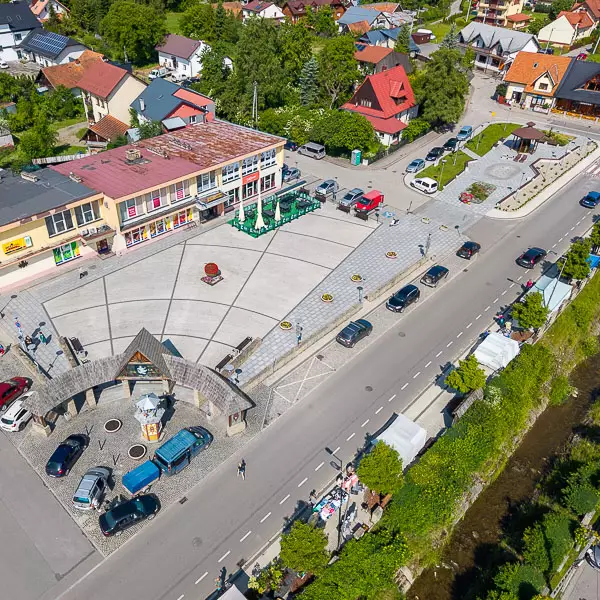
In the 1970s, the municipal authorities carried out the first restructuring of the market square. The surface was leveled, a department store was built, and trees were planted, partly changing the square’s function. Modern transformations have given the square a new character. During the first revitalization (2014/2015), a granite surface and the Łącko Gate were introduced, which organized pedestrian traffic and gave the space a representative look. The second major modernization (2023) focused on the small park: a saline graduation tower and an illuminated ground fountain were added, along with benches, deck chairs, and greenery. The outcome of these stages is clear: the market square has evolved from a place of transit and trade into a contemporary center — a meeting point, a venue for events, and a space for short breaks during a visit.
To protect the inhabitants of Łącko, who were plagued by fires each year, parish priest Kacper Czekayski in 1824 purchased a painting and a statue of St. Florian, the patron saint against fire. The painting was placed in the altar of the parish church, while the statue was carried in processions through the village. In the same year, a small chapel was built to house the figure, located near the bridge over the Czarny Potok stream. At the end of World War II, the Germans blew up the crossing; the chapel was destroyed, but the statue of St. Florian survived.
At that time, Władysław Bubiec, who worked for the municipal office in Łącko, came up with the idea of placing the statue of St. Florian on a well situated at the edge of the market square. Before World War II, this was a traditional well, located in the center of the Jewish quarter. It stood behind the building that housed the “Szczawnica” hotel and restaurant.
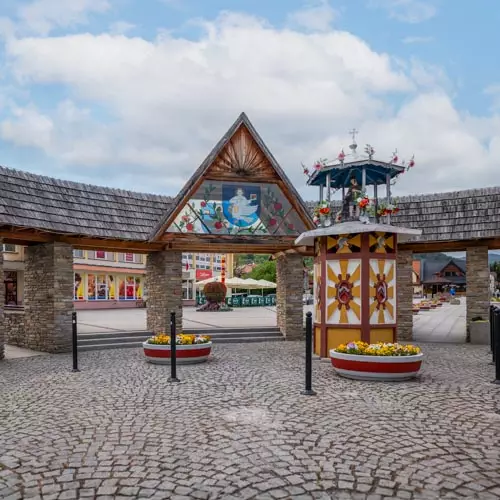
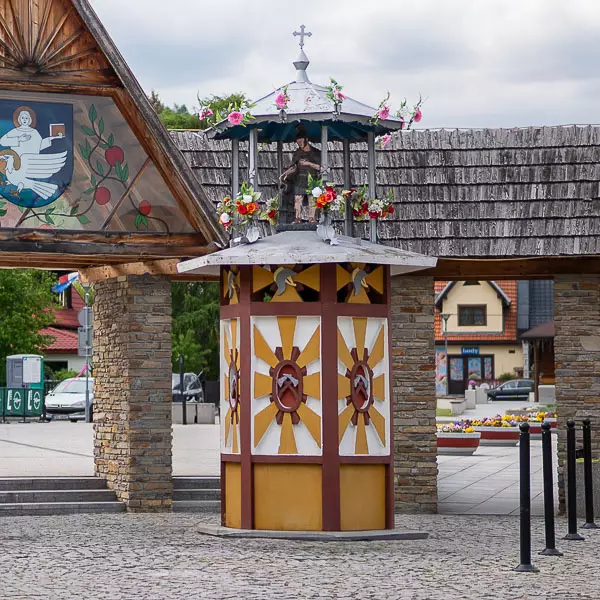
Today, the St. Florian well has taken the form of an octagonal chapel with a multi-sloped roof topped with a cross. Inside stands a statue of the saint in a classical depiction; the pedestal is decorated with radiant panels featuring firefighting motifs (axes and helmets), along with a cornice, ribbons, and floral ornaments. At the base, a circular arrangement of cobblestones marks the well’s area and organizes the composition of the market square. According to oral accounts, the well served as a functioning water source until the 1970s, after which it became a recognizable landmark of Łącko. Today, a plastic copy of the statue of St. Florian is placed on the pedestal, while the original is kept in the building of the Volunteer Fire Department in Łącko.
The Łącko Gate is a stone-and-wood shelter with a shingle roof, built during the first revitalization of the market square (around 2013–2014). The structure, composed of three spans on masonry pillars with a central gable, features a decorative panel referencing the municipality’s coat of arms and the local symbolism of fruit-growing. The gate serves both a representative and an organizing role, acting as the main accent at the entrance to the square. The use of materials and details—split stone, wood, shingles, and stained-glass inserts—blends contemporary design with the building traditions of the region.
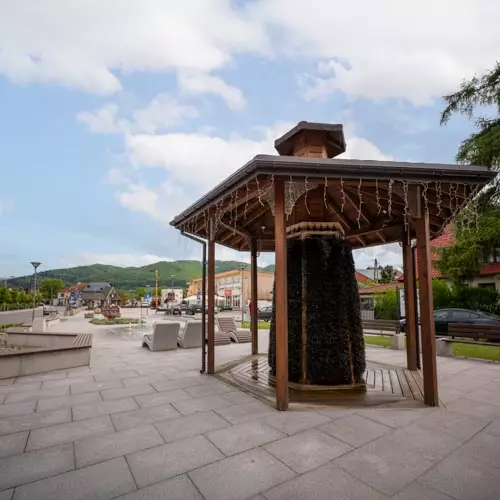
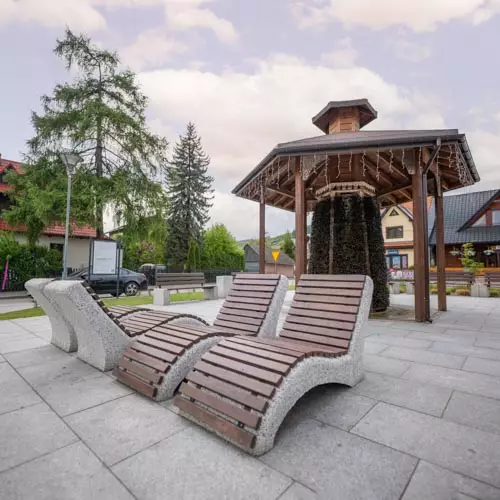
The saline graduation tower and ground fountain on the market square in Łącko were built as part of the town center’s revitalization and opened at the end of 2023. The graduation tower, with a footprint of about 11 m², produces a saline aerosol with health benefits and is freely accessible to the public. The ground fountain, with jets integrated into the surface and lighting, serves both recreational and cooling functions during the summer season. Both features are complemented by small architectural elements—benches, deck chairs, and greenery—creating a welcoming relaxation zone in the market square.